
Build Your Affiliate Store with SelPage
Create a store, choose its visual style, organize its catalog, and share one public address. Start after completing your account setup and selecting a plan.
Last reviewed: 11 October 2026.
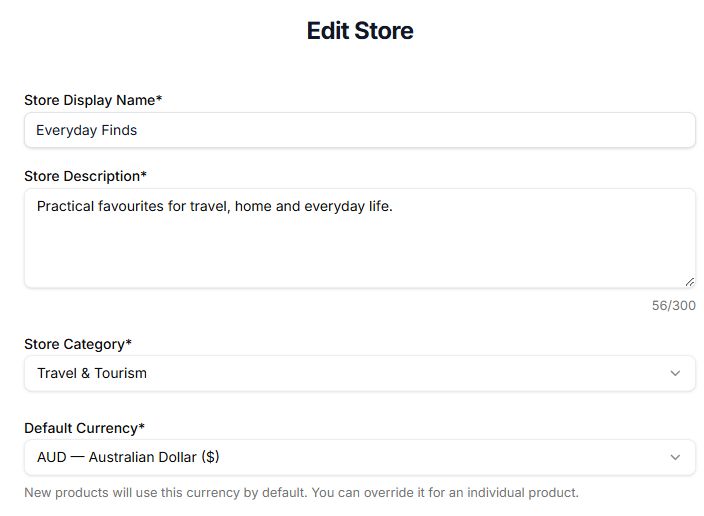
Screenshots show the current store editor with an example store. The same fields are used during creation; use your own store details. Select any screenshot to open it at full size.
1. Open Store Creation
- Sign in and select Store in the dashboard sidebar.
- On the store list, select Add new store. You can also use Create store from the dashboard when that action is available.
If you see Select a plan or Upgrade plan, review your subscription and remaining capacity first.
2. Complete the Store Fields
| Field | How to use it |
|---|---|
| Store Display Name | The name visitors see. Choose a name that describes your collection. |
| Store Description | A required summary of up to 300 characters. The form shows a character counter. |
| Store Category | The overall category for the store. This is separate from product browsing categories. |
| Default Currency | The starting currency for new products. Choose the currency code that matches your catalog. |
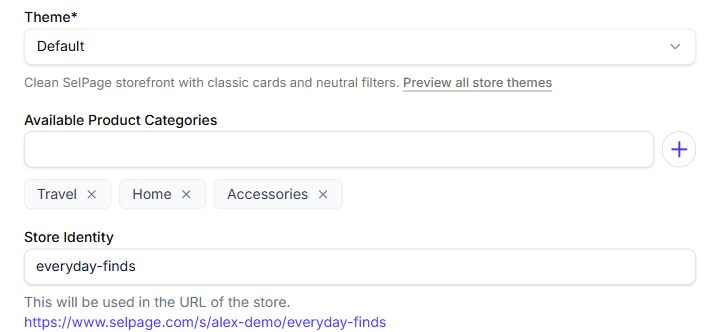
| Theme | A storefront style chosen from the 11 available themes. |
| Available Product Categories | Your category names for grouping products within this store. |
| Store Identity | The store's address identifier. Start with a letter and use English letters, numbers, or hyphens. Check the Available or Unavailable message. |
| Banner image | An optional JPG, JPEG, or PNG up to 10 MB. Use an image that works with your selected theme. |
| Store status | The active/inactive switch controls whether the store is available publicly. |
The public address uses your profile username and store identity: https://www.selpage.com/s/your-username/your-store. Review the address shown below Store Identity before sharing it.
3. Choose and Preview Your Store Theme
- Select Preview all store themes below the Theme field, or open the store theme gallery.
- Browse all 11 styles or filter for a light, dark, or natural look. Select Preview theme on a card.
- Switch between Desktop and Mobile to compare the banner, typography, filters, and product cards.
- Return to the builder, choose the matching name in Theme, and select Submit to save.
Previews use the same sample catalog and do not change your store. Try Boutique for fashion, Midnight for tech, or Wellness for lifestyle collections. You can change the theme later while keeping your products.
4. Set Up Product Categories and Currency
Under Available Product Categories, enter a category name and select the plus button (Add product category), or press Enter. Add names such as Tech, Home, or Skincare, then submit the store form to save them. Use the removal control next to a category to remove it from the available list.
When adding or editing a product, choose one of these names in Product Category. If the dropdown has no choices, return to the store fields and save at least one category. Products can also be left without a category.
Default Currency supplies the initial currency for new products. A priced product has its own Currency field; editing an existing product keeps its saved currency. See Define Your Products for prices and category assignment.
5. Save, Add Products, and Check the Public Store
- Set the active/inactive switch as intended and select Submit.
- On the saved store page, scroll to Products and use Add new product.
- Use View from the dashboard or View Store from the store list to open the public storefront.
- Check your banner, categories, product descriptions, prices, and affiliate links on desktop and mobile before sharing the address.
A product must also be active to appear in an active store. If the app reports a delay refreshing the public page after saving, allow time for that refresh and check the public view again.
6. Edit, Hide, or Delete a Store
Use Edit on the dashboard or Edit Store in the store list to update the store fields and manage products. Make your changes and select Submit.
Switch the store to inactive and submit to hide it publicly while retaining its saved content. Use the Store list's delete control and review its confirmation if you want to remove a store. An inactive store can be managed from the Store list even when it is absent from the dashboard's active-store table.
After publishing, use Track Performance to read the dashboard's visit counters and compare store traffic.


