
Track Your SelPage Store Performance
The dashboard shows recorded visits, store capacity, product counts, and how traffic is distributed across your active stores. Use these measures to decide what to review next.
Last reviewed: 11 October 2026.
Screenshots show the current dashboard with illustrative account, plan, and visit data. Your own figures will differ. Select any screenshot to open it at full size.
1. Open Your Dashboard
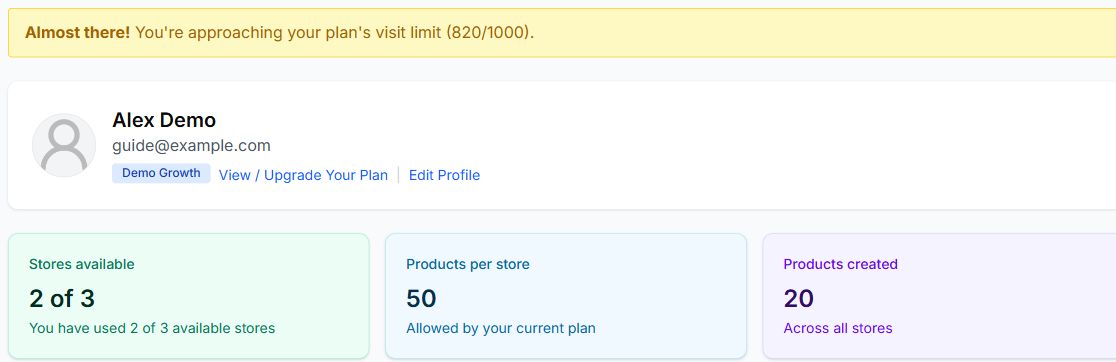
Sign in and open Dashboard. Review the account and plan information, capacity cards, Your Stores table, and Store Traffic Distribution chart.
Stores available shows remaining capacity, Products per store shows the plan allowance, and Products created sums the product counts in the displayed stores. Use Create store, Select a plan, or Upgrade plan as shown.
2. Understand the Reporting Period
The current dashboard uses visit counters for the current calendar month in UTC. When a new month starts, it reads that month's counters rather than the previous month's totals.
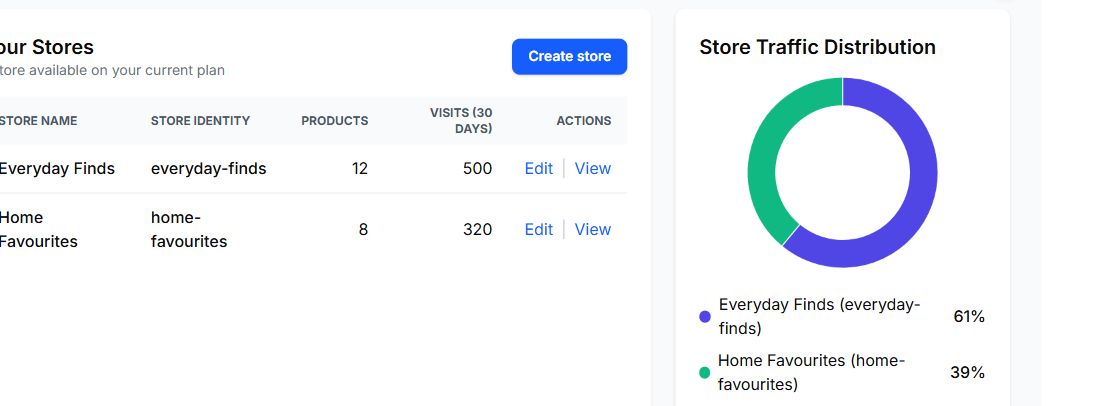
The store table currently labels its visit column Visits (30 days). The underlying figures are current-month counts, rather than a rolling 30-day history. Compare results within the same month.
Recorded visits are counts of recorded page visits, rather than a count of unique people. The dashboard does not report affiliate sales, commissions, outbound product clicks, or conversion rates. Use your affiliate program's reporting for those results.
3. Read the Your Stores Table
| Column | What it means |
|---|---|
| Store Name | The display name of an active store. |
| Store Identity | The identifier in that store's public address. |
| Products | Saved products that have not been deleted, including inactive products. This is not a count of only publicly visible products. |
| Visits (30 days) | Recorded visits for the current month, despite the column label. |
| Edit | Opens the saved store page to update fields or manage products. |
| View | Opens the public store in a new tab. |
The dashboard table includes active, non-deleted stores. To manage an inactive store, open Store in the sidebar.
4. Compare Store Traffic Distribution
The donut chart shows each displayed store's share of the combined visits to the active stores in the table. Colors and the legend identify the store and its rounded percentage.
For example, a store with 30 recorded visits out of 100 combined store visits has a 30% share. This is a share of traffic, rather than a conversion rate. Rounded percentages may not add up to exactly 100%.
When there are no recorded store visits, percentages are zero and there is no meaningful traffic share to compare yet. Account visit usage can differ from the sum shown in the table because it also includes visits recorded outside the displayed active stores.
5. Review Visit Usage and Plan Alerts
The dashboard compares recorded account visits with the allowance supplied for your plan. It shows an approaching-limit alert from 80% usage and an exceeded-limit alert at 100% or above.
Review the alert and open Plan to compare capacity and available options. Store and product allowances are separate from visit usage, so check all three when planning a larger catalog.
6. Use the Results to Review Your Store
- Compare store visits within the same month to see which collections attract traffic.
- Use View to review the public page of a store with fewer visits. Check your shared address, active status, banner, and product content.
- Review product names, descriptions, affiliate links, and category assignments.
- Compare desktop and mobile theme previews, apply your choice in the builder, and check your own content on both screen sizes.
- Check your affiliate program reports separately to understand purchases and commissions.
Revisit the dashboard after sharing your collection. A theme change is a presentation choice; visit counts alone do not establish that it caused a change in sales.


